
Studying medicine does not always mean pursuing a career in clinical services. Fakih, an alumnus of the Faculty of Medicine at Universitas Muhammadiyah Surakarta (UMS), has proven this by building a career in hospital management.
Fakih shared that he began focusing on hospital management while working at Pala Raya Mother and Child Hospital in Tegal, Central Java, in 2017. At the time, he served as Deputy Director of Services. His main responsibility was to oversee clinical departments to ensure high-quality patient care and compliance with medical protocols.
“As it happened, the hospital needed regeneration. So I joined, but I still started from the bottom—working as an emergency room doctor, then as the physician in charge of inpatient care. So I continued to perform my role as a functional doctor,” recalled the Sukoharjo-born physician.
In 2019, he was given the opportunity to become Director of RSIA Pala Raya Tegal. His responsibilities expanded significantly, including leading the hospital and providing strategic direction for operations, finance, and medical services.
In 2022, Fakih decided to move to Surabaya due to family matters. Meanwhile, he began a new role as Deputy Director of General Affairs and Finance at Undaan Eye Hospital in Surabaya.
According to him, working in hospital management has a broader impact. “It’s not just person-to-person, but also extends to the healthcare system,” he said.
Currently, he serves as Director of Operations at PT Bersama Mata Undaan. His role involves supporting the foundation’s operations in expanding clinics and hospitals across several regions in East Java.
“At present, I handle business development, including what has already been established—such as the main clinic in Sidoarjo, a primary clinic in Pare, Kediri, and, God willing, plans this year to open several eye clinics in various areas of East Java,” said the 2014 UMS medical graduate.
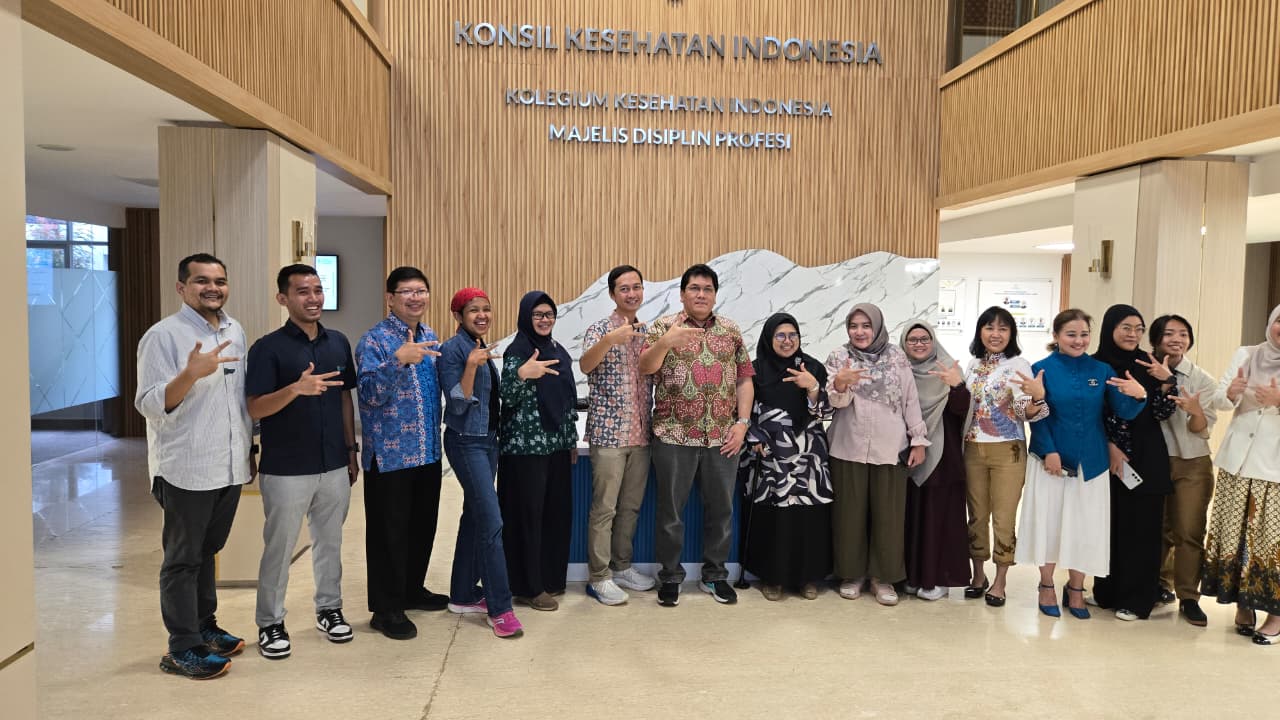
Fakih Nur Salimi Latief (third from left) with members of the Indonesian College of Physicians. Private doc.
Active in Organizations
During his studies at the Faculty of Medicine UMS from 2007 to 2014, Fakih was actively involved in student organizations. One of them was the Student Executive Board (BEM) of the Faculty of Medicine UMS, where he served as Minister of Research in 2008 and Chairperson in 2009.
He was also active in the Indonesian Medical Students’ Senate Association (ISMKI) as Regional Secretary for Region 3 in 2010. A year later, he was entrusted with the position of Secretary General.
His passion for management was evident early on. He jokingly said that his involvement in organizations forced him to delay his clinical internship (co-assistantship) for half a year.
“After graduating with my bachelor’s degree, I didn’t immediately start my clinical rotation because I was entrusted as Secretary General of ISMKI, so I decided to delay it by about half a year,” he said.
Even after entering hospital management, he remains active in several organizations, including the Indonesian Medical Association, Junior Doctors Network Indonesia, and the Indonesian College of Physicians.
Learning to Broaden Perspectives
Fakih believes that doctors must be willing to broaden their knowledge beyond the medical field. This belief led him to pursue a law degree at Universitas Terbuka in 2014.
“Studying law was actually intended to support my medical practice. At that time, there were many cases of doctors being criminalized, so I saw how important it is for doctors to understand the law,” he explained.
He later pursued several master’s degrees at different universities, including a Master of Health Administration at Esa Unggul University, a Master of Law at Universitas Islam Nusantara, and a Master of Management at Harapan Bangsa School of Economics.
Fakih encourages medical students and graduates, especially those from UMS, to broaden their perspectives, as career paths for medical graduates are highly diverse—from practitioners, academics, and researchers to even politicians. “For example, politicians with a medical background can create policies that have a real impact on doctors,” he said.
Broadening perspectives is also essential for doctors to stay responsive to changing times. The emergence of artificial intelligence such as ChatGPT, Gemini, and similar tools has made the medical profession more challenging.
“We will face patients who may already have awareness of their own health. They may not even see doctors as their only reference,” he added.
In addition to keeping up with technological developments, Fakih emphasized that communication skills are crucial for doctors. These skills help them explain medical perspectives to patients and balance information provided by AI, ensuring that public trust in medical institutions is maintained.